Genus
Genus
From Wikipedia, the free encyclopedia
"Genera" redirects here. For the operating system, see Genera (operating system).
For other uses, see Genus (disambiguation).

This article needs additional citations for verification.
Please help improve this article by adding reliable references. Unsourced material may be challenged and removed. (August 2006)
In biology, a genus (plural: genera) is a low-level taxonomic rank used in the classification of living and fossil organisms, which is an example of definition by genus and differentia. The term comes from Latin genus "descent, family, type, gender",[1] cognate with Greek: γένος – genos, "race, stock, kin".[2]
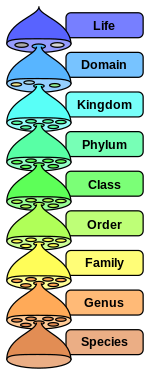
 The hierarchy of biological classification's eight major taxonomic ranks, which is an example of definition by genus and differentia. A family contains one or more genera. Intermediate minor rankings are not shown.
The composition of a genus is determined by a taxonomist. The standards for genus classification are not strictly codified, and hence different authorities often produce different classifications for genera. In the hierarchy of the binomial classification system, genus comes above species and below family.
Contents
[hide]
[edit] Generic name
The scientific name of a genus may be called the generic name or generic epithet: it is always capitalized. It plays a pivotal role in binomial nomenclature, the system of biological nomenclature.
[edit] Binomial nomenclature
The rules for scientific names are laid down in the Nomenclature Codes; depending on the kind of organism and the Kingdom it belongs to, a different Code may apply, with different rules, laid down in a different terminology. The advantages of scientific over common names are that they are accepted by speakers of all languages, and that each species has only one name. This reduces the confusion that may arise from the use of a common name to designate different things in different places (example elk), or from the existence of several common names for a single species.
It is possible for a genus to be assigned to a kingdom governed by one particular Nomenclature Code by one taxonomist, while other taxonomists assign it to a kingdom governed by a different Code, but this is the exception, not the rule.
[edit] Pivotal in binomial nomenclature
The generic name often is a component of the names of taxa of lower rank. For example, Canis lupus is the scientific name of the Gray wolf, a species, with Canis the generic name for the dog and its close relatives, and with lupus particular (specific) for the wolf (lupus is written in lower case). Similarly, Canis lupus familiaris is the scientific name for the domestic dog.
Taxonomic units in higher ranks often have a name that is based on a generic name, such as the family name Canidae, which is based on Canis. However, not all names in higher ranks are necessarily based on the name of a genus: for example, Carnivora is the name for the order to which the dog belongs.
[edit] The problem of identical names used for different genera
A genus in one kingdom is allowed to bear a scientific name that is in use as a generic name (or the name of a taxon in another rank) in a kingdom that is governed by a different Nomenclature Code. Although this is discouraged by both the International Code of Zoological Nomenclature and the International Code of Botanical Nomenclature, there are some five thousand such names that are in use in more than one kingdom. For instance, Anura is the name of the order of frogs but also is the name of a genus of plants (although not current: it is a synonym); Aotus is the genus of golden peas and night monkeys; Oenanthe is the genus of wheatears and water dropworts, Prunella is the genus of accentors and self-heal, and Proboscidea is the order of elephants and the genus of devil's claws.
Within the same kingdom one generic name can apply to only one genus. This explains why the platypus genus is named Ornithorhynchus—George Shaw named it Platypus in 1799, but the name Platypus had already been given to a group of ambrosia beetles by Johann Friedrich Wilhelm Herbst in 1793. Names with the same form but applying to different taxa are called homonyms. Since beetles and platypuses are both members of the kingdom Animalia, the name Platypus could not be used for both. Johann Friedrich Blumenbach published the replacement name Ornithorhynchus in 1800.
[edit] Types and genera
Because of the rules of scientific naming, or "binomial nomenclature", each genus should have a designated type, although in practice there is a backlog of older names that may not yet have a type. In zoology this is the type species (see Type (zoology)); the generic name is permanently associated with the type specimen of its type species. Should this specimen turn out to be assignable to another genus, the generic name linked to it becomes a junior synonym, and the remaining taxa in the former genus need to be reassessed.
See scientific classification and Nomenclature Codes for more details of this system. Also see type genus.
[Guidelines
There are no hard and fast rules that a taxonomist has to follow in deciding what does and what does not belong in a particular genus. This does not mean that there is no common ground among taxonomists in what constitutes a "good" genus. For instance, some rules-of-thumb for delimiting a genus are outlined in Gill.[3] According to these, a genus should fulfill three criteria to be descriptively useful:
- monophyly – all descendants of an ancestral taxon are grouped together;
- reasonable compactness – a genus should not be expanded needlessly; and
- distinctness – in regards of evolutionarily relevant criteria, i.e. ecology, morphology, or biogeography; note that DNA sequences are a consequence rather than a condition of diverging evolutionary lineages except in cases where they directly inhibit gene flow (e.g. postzygotic barriers).
[edit] Nomenclature
...difficulties occurring in generic nomenclature: similar cases abound, and become complicated by the different views taken of the matter by the various taxonomists.
Prof. C. S. Rafinesque. 1836[4]
None of the Nomenclature Codes require such criteria for defining a genus, because these are concerned with the nomenclature rules, not with taxonomy. These regulate formal nomenclature, aiming for universal and stable scientific names.
 |
This article needs additional citations for verification. Please help improve this article by adding reliable references. Unsourced material may be challenged and removed. (August 2006) |
In biology, a genus (plural: genera) is a low-level taxonomic rank used in the classification of living and fossil organisms, which is an example of definition by genus and differentia. The term comes from Latin genus "descent, family, type, gender",[1] cognate with Greek: γένος – genos, "race, stock, kin".[2]

The composition of a genus is determined by a taxonomist. The standards for genus classification are not strictly codified, and hence different authorities often produce different classifications for genera. In the hierarchy of the binomial classification system, genus comes above species and below family.
Contents[hide] |
[edit] Generic name
The scientific name of a genus may be called the generic name or generic epithet: it is always capitalized. It plays a pivotal role in binomial nomenclature, the system of biological nomenclature.
[edit] Binomial nomenclature
The rules for scientific names are laid down in the Nomenclature Codes; depending on the kind of organism and the Kingdom it belongs to, a different Code may apply, with different rules, laid down in a different terminology. The advantages of scientific over common names are that they are accepted by speakers of all languages, and that each species has only one name. This reduces the confusion that may arise from the use of a common name to designate different things in different places (example elk), or from the existence of several common names for a single species.
It is possible for a genus to be assigned to a kingdom governed by one particular Nomenclature Code by one taxonomist, while other taxonomists assign it to a kingdom governed by a different Code, but this is the exception, not the rule.
[edit] Pivotal in binomial nomenclature
The generic name often is a component of the names of taxa of lower rank. For example, Canis lupus is the scientific name of the Gray wolf, a species, with Canis the generic name for the dog and its close relatives, and with lupus particular (specific) for the wolf (lupus is written in lower case). Similarly, Canis lupus familiaris is the scientific name for the domestic dog.
Taxonomic units in higher ranks often have a name that is based on a generic name, such as the family name Canidae, which is based on Canis. However, not all names in higher ranks are necessarily based on the name of a genus: for example, Carnivora is the name for the order to which the dog belongs.
[edit] The problem of identical names used for different genera
A genus in one kingdom is allowed to bear a scientific name that is in use as a generic name (or the name of a taxon in another rank) in a kingdom that is governed by a different Nomenclature Code. Although this is discouraged by both the International Code of Zoological Nomenclature and the International Code of Botanical Nomenclature, there are some five thousand such names that are in use in more than one kingdom. For instance, Anura is the name of the order of frogs but also is the name of a genus of plants (although not current: it is a synonym); Aotus is the genus of golden peas and night monkeys; Oenanthe is the genus of wheatears and water dropworts, Prunella is the genus of accentors and self-heal, and Proboscidea is the order of elephants and the genus of devil's claws.
Within the same kingdom one generic name can apply to only one genus. This explains why the platypus genus is named Ornithorhynchus—George Shaw named it Platypus in 1799, but the name Platypus had already been given to a group of ambrosia beetles by Johann Friedrich Wilhelm Herbst in 1793. Names with the same form but applying to different taxa are called homonyms. Since beetles and platypuses are both members of the kingdom Animalia, the name Platypus could not be used for both. Johann Friedrich Blumenbach published the replacement name Ornithorhynchus in 1800.
[edit] Types and genera
Because of the rules of scientific naming, or "binomial nomenclature", each genus should have a designated type, although in practice there is a backlog of older names that may not yet have a type. In zoology this is the type species (see Type (zoology)); the generic name is permanently associated with the type specimen of its type species. Should this specimen turn out to be assignable to another genus, the generic name linked to it becomes a junior synonym, and the remaining taxa in the former genus need to be reassessed.
See scientific classification and Nomenclature Codes for more details of this system. Also see type genus.
[Guidelines
There are no hard and fast rules that a taxonomist has to follow in deciding what does and what does not belong in a particular genus. This does not mean that there is no common ground among taxonomists in what constitutes a "good" genus. For instance, some rules-of-thumb for delimiting a genus are outlined in Gill.[3] According to these, a genus should fulfill three criteria to be descriptively useful:
- monophyly – all descendants of an ancestral taxon are grouped together;
- reasonable compactness – a genus should not be expanded needlessly; and
- distinctness – in regards of evolutionarily relevant criteria, i.e. ecology, morphology, or biogeography; note that DNA sequences are a consequence rather than a condition of diverging evolutionary lineages except in cases where they directly inhibit gene flow (e.g. postzygotic barriers).
[edit] Nomenclature
...difficulties occurring in generic nomenclature: similar cases abound, and become complicated by the different views taken of the matter by the various taxonomists.
None of the Nomenclature Codes require such criteria for defining a genus, because these are concerned with the nomenclature rules, not with taxonomy. These regulate formal nomenclature, aiming for universal and stable scientific names.


.svg)

